
I recently read Ramabanam, a Tamil novella written by Suchitra Ramachandran. She is an author, translator, and editor of an online magazine, and one of the founders of Mozhi Spaces — an initiative that aims to bring together literatures across Indian languages.
One of the reasons I immediately jumped into reading the novella was the premise (Carnatic music and the Cauvery) — a topic dear to me — and its length. As I read, it threw more and more surprises at me, which I would like to discuss here. First, it is a speculative fiction work — dealing especially with alternative mythology, which is not very common in Tamil literature. In a way, mythology is an alternate history, creating images to represent certain values and virtues, passed over generations through memory. The reason I call this work alternative mythology rather than history is that the story of Tyagaraja survives and is conveyed as mythology rather than with the accuracy of historical events in public imagination. Even in the novella, Thillaisthanam Ramudu narrates the story that was told to him by his guru — it comes across more as a mythological tale than a historical memory.
The conversation between Ramudu, Meenakshinadhan, and Sambu sets the stage for the grand drama that unfolds later in the novella. The conversation the trio have in a mantapa near the magnificent Cauvery, overnight, through different topics and experiences, will make readers ruminate on what is past, future, and timeless. Sambu, who is studying modern history, is excited about a new future; Meenakshi, fascinated with the past, is in search of something timeless; Ramudu, who leads the conversation, talks about his struggle to find something perennial across time and space.
Meenakshi, who is completely absorbed in the research of palm-leaf manuscripts, is on the hunt to find the timeless truth — something indestructible among the things that perish. On the other hand, Sambu, a representative of the modern agency, talks about the changing times. He speaks of an objective, rational interpretation of reality, rather than a subjective one. But Suchitra might have intentionally designed the Sambu character to be slightly weak in this juxtaposition — perhaps showing her soft criticism of the modern binary interpretation of history. Ramudu, who was abandoned by society and his family, possesses a critical view of the hypocritical lifestyle of his half-brothers and the ritualistic worship of the almighty. He is in pursuit of realising the omnipresence of the almighty, waiting for Ram’s arrow to hit him one day. The beauty of this first half is that all the philosophical questions and points of view are dramatised through poetic, intense, and detailed accounts of life events. The author doesn’t preach to the reader about the clash of different worldviews. Ramudu’s description of the Cauvery, Meenakshi’s moment of finding the manuscript, and Ramamridam Pillai’s backstory are beautifully narrated.
The contrasting perspectives of Meenakshi and Sambu lead Ramudu to synthesise a philosophical view by narrating the story of Tyagaraja. Suchitra does not shy away from re-narrating the well-known mythology in the space of music and culture. Let’s familiarise ourselves with a few names and facts to understand what is redefined and approach the text more deeply. Tyagaraja had two brothers — Panchanada Brahmam and Panchapakesa Brahmam. Panchapakesa Brahmam died early, so it was Panchanada Brahmam who took care of household and agricultural activities. Panchanada Brahmam was also called Japyesa, after the name of the deity (Lord Shiva) of Thiruvaiyaru. Historically, or as per widespread mythology, Japyesa or Panchanada is portrayed as a materialistic family man, not someone with strong philosophical or musical knowledge. Now, let’s look at the interesting choice of names in the novella. Panchanada Brahmam and Japyesa are two names for the same person. But the character with shades of Tyagaraja is named Panchanadha Brahman, and the character shown as flamboyant is named Japyesa. Suchitra makes them twins, representing two different philosophical views.
I don’t want to analyse the meaning of the names, as I am not doing a religio-cultural analysis — like how Japyesa calls himself a Shiva worshipper, yet his character is more like Vishnu or Krishna. That should not be the concern for the reader. The author uses these characters to discuss two contrasting views and a quest for salvation. They are like two sides of the same coin. At times I wondered: are they the same person with split personality disorder (the text allows such an assumption) rather than two different persons? While Panchanadha Brahman subscribes to an ascetic, devotional path, Japyesa devotes his life to music and pleasures. But he is unapologetic, because he sees the essence of Rama in everything — a blissful universe made of Rama. One sees nothing but Rama; the other sees Rama in everything.
Their conversation with Ramamridham Pillai about their childhood reveals something to the readers. Japyesa, who held the Ram idol close to his heart, moved away and found him in the music; Panchanadha, who stood away showing him the arti, moved closer to Ram through his idol. This interesting contradiction reveals more about the characters in the novel.
Ramavani’s relationship with Japyesa was subtle, while her encounter with Panchanadha was even more intriguing. In fact, Panchanadha’s transformation began with that meeting — he was startled upon witnessing something in Ramavani at the temple, which prompted him to say, “Sarveshu ramante iti Rama,” the same line quoted by Japyesa in the previous passage. This long battle reaches its climax when Japyesa, taunting Panchanadha, jumps into the river with the Ram idol, prompting Panchanadha to follow him. However, they returned as a single person, now named Tyagarbrahmam — no one could tell whether that person was Japyesa or Panchanadha.There are beautiful passages about the creation of art and the conversion of pain into music. Since the premise is music, references to a few beautiful Tyagaraja kritis are naturally included in the Novella.
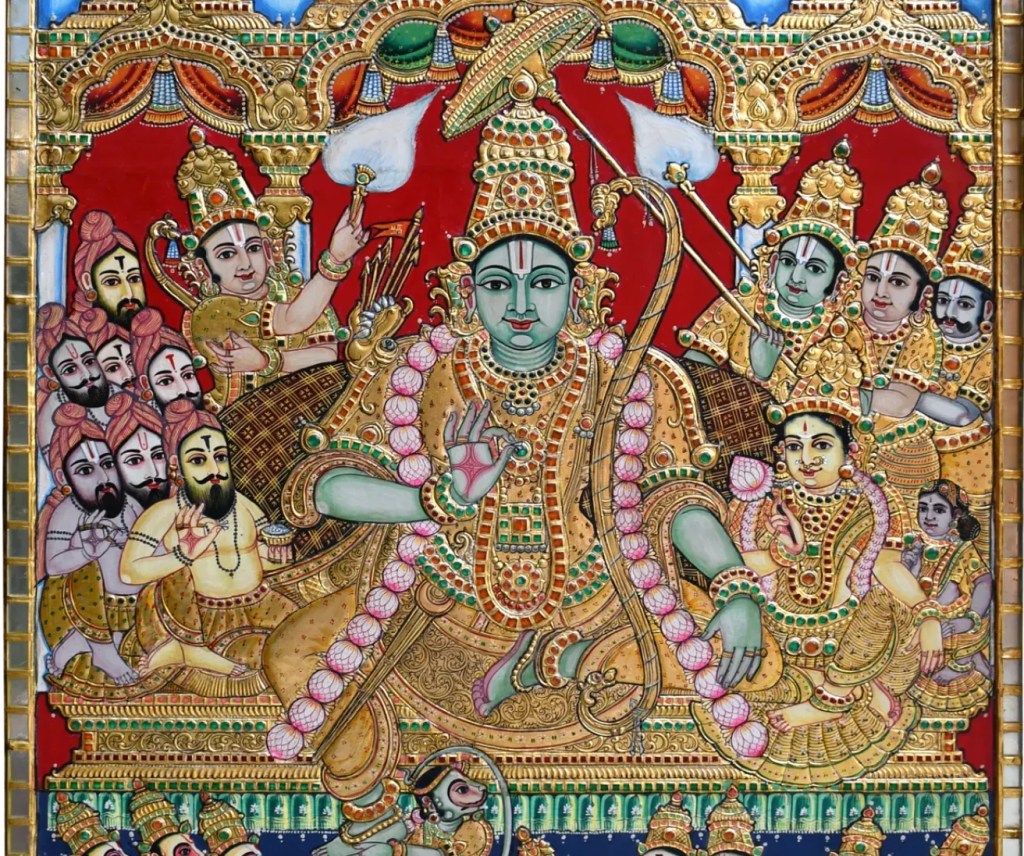
Now let’s come back to the title Ramabanam — the arrow of Ram. Whether Ram’s arrow killed Valli or merged Vali and Sugriva, did the same arrow merge Japyesa and Panchanadha? Why did Suchitra choose this story to re-narrate? Conflicting views and perspectives have existed for centuries. The path of Bhakti or the path of wisdom? The path of knowledge? The path of belief? Things perish and are replaced by something else. What survives and guides humanity through the centuries? What is the invisible underlying force that runs across and connects everything? In a time when Ram is positioned as a political icon, it is the duty of art and literature to reclaim these values and iconographies, and position them where they belong — as the eternal uniting force. Suchitra reminds us that the name Ram is a uniting force, not a dividing one. Through retelling the story in a cultural space and refusing to enter the political narrative, she achieves an even more powerful impact on the reader.
I have one issue with this novella. Author Suneel Krishnan mentioned in his blog that it has multiple centres, with overwhelming images and metaphors. I feel this has the potential of a novel rather than a novella; hence, the multiple threads appear as multiple centres. Finally, like Meenakshinadhan, who finds his answer in the eternal river with no origin or end, the novella demands that the reader find their own. I hope this wonderful novella will be translated into English very soon.
 Neraval
Leave a comment